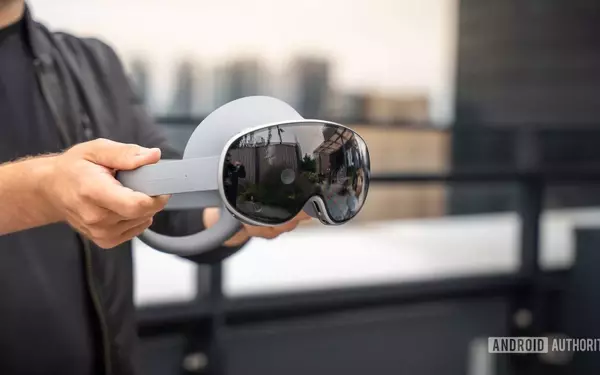
The Samsung Galaxy XR headset marks a significant advancement in extended reality technology, showcasing exceptional spatial awareness and deep integration with Gemini AI. While impressive, its substantial form factor hints at a transitional role, paving the way for more compact, AI-powered smart glasses that could redefine personal computing. This device blurs the lines between physical and digital, offering a glimpse into a future where augmented reality becomes an integral part of daily life.
A year after its initial prototype, the Galaxy XR has evolved into a polished product, featuring a 4K-per-eye display that renders the real world with remarkable clarity. This refined hardware, coupled with the seamless functionality of Gemini AI, transforms the user experience, allowing for intuitive interactions and a heightened sense of immersion. Despite its capabilities, the headset's design suggests that the ultimate vision for augmented reality lies in smaller, more discreet wearables, making the Galaxy XR an important, yet interim, development in the journey toward pervasive smart eyewear.
Evolution of the Galaxy XR Headset and AI Integration
Samsung's Galaxy XR headset has undergone substantial refinement since its early prototype, demonstrating remarkable progress in both hardware and software. Initially conceived as Project Moohan, the device now boasts a premium build quality and an advanced 4K-per-eye pass-through camera, providing a lifelike and spatially accurate view of the real world. This enhanced visual fidelity, where physical objects and virtual overlays merge seamlessly, creates an immersive experience that significantly blurs the distinction between the real and digital environments. The improvements allow for clear perception of fine details and precise anchoring of virtual elements, making the augmented reality feel genuinely integrated with the user's surroundings. The only minor drawback noted was a slight regression in hand-tracking ease compared to the initial prototype, requiring more deliberate gestures for accurate control.
A key aspect of the Galaxy XR's evolution is the deep integration of Google's Gemini AI layer, which has matured from a promising concept to a robust command interface. Gemini now facilitates various OS-level tasks, such as launching applications and organizing the visual workspace, and enables "circle to search" functionality across both the operating system and pass-through mode. While much of this AI processing occurs in the cloud, its on-device capabilities signal a future where AI serves as the primary control mechanism for digital interactions. This seamless integration of high-quality pass-through technology with Gemini AI creates a powerful synergy, offering instant context and meaning to the user's perception of the world. This pairing is seen as a crucial step towards smaller, more accessible AI and XR-driven glasses, suggesting that the current headset form factor, despite its advancements, is a temporary stage in the broader development of ambient computing.
The Dual Purpose: Immersion Versus Utility
The Samsung Galaxy XR headset highlights a fundamental distinction in the realm of augmented and virtual reality: the trade-off between immersive experiences and practical utility. While AI glasses prioritize integrating digital information into daily life in a discreet manner, the Galaxy XR excels at creating deeply immersive environments that transport users beyond their immediate surroundings. For instance, the headset can transform static black-and-white photos into dynamic, colorized 3D spatial videos, offering a profoundly emotional and unique way to revisit memories. This capacity for powerful, lifelike immersion, improved significantly from earlier prototypes by smoothing out visual imperfections and enhancing real-time spatialization, allows for unprecedented levels of engagement with digital content.
However, the article emphasizes that the large form factor of the Galaxy XR, while enabling these rich immersive experiences, inherently limits its everyday utility. Wearing such a device for mundane tasks, like navigating city streets with a map overlay, is impractical and unlikely to be adopted by users. This limitation positions the Galaxy XR as more of a "gateway device" than a final product for pervasive augmented reality. The seamless integration of Gemini AI technology acts as a bridge between these two paradigms, enhancing the immersive qualities within the headset while also hinting at its potential to empower future, more portable smart glasses with real-time, contextual intelligence. The ongoing development, with major tech companies reallocating resources towards smaller smart glasses, underscores the industry's recognition that true mass adoption of AR/XR will require devices that blend seamlessly into daily life without sacrificing functionality.