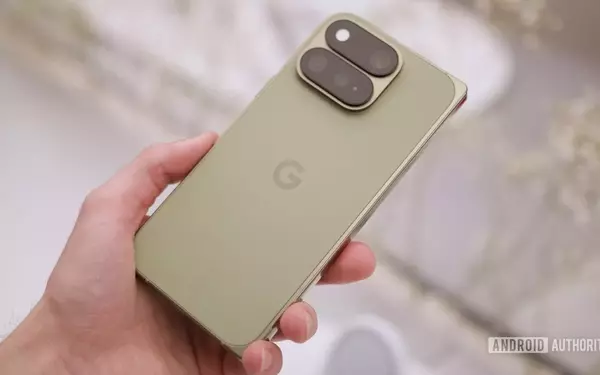
Google's latest foldable device, the Pixel 11 Pro Fold, has encountered significant durability setbacks during rigorous testing, exhibiting a recurring weakness at its antenna lines. This vulnerability has been consistently observed across four generations of Google's foldable smartphones, prompting questions about the design and material choices, despite the manufacturer's assertions of improved structural integrity. The tests also revealed conventional scratch resistance for its outer screen and limited resilience of both displays to direct flame exposure.
Furthermore, fine particulate matter managed to infiltrate the hinge mechanism, even with the device's IP68 rating, underscoring the complexities of dust resistance in gadgets with moving components. The most striking finding was the phone's complete separation along the antenna lines during the bending assessment, with the front glass detaching without residual connections to internal wiring. These results collectively highlight persistent engineering hurdles for Google in developing robust foldable technology.
Recurring Structural Flaws in Foldable Devices
Google's Pixel 11 Pro Fold has again failed to withstand a comprehensive durability examination, specifically demonstrating a critical fracture along its antenna lines during a bending stress test. This issue is not new, as it has been a consistent point of failure for the past four iterations of Google's foldable smartphone series. Despite the company's prior assurances regarding a threefold increase in structural robustness and a hinge mechanism capable of enduring millions of cycles in controlled laboratory environments, the real-world performance indicates that a fundamental weak point remains unaddressed.
The latest assessment, conducted by the reputable YouTube channel JerryRigEverything, rigorously put the Pixel 11 Pro Fold through a series of demanding trials, including scratch, flame, dust, and bend tests. The results unequivocally pointed to the antenna lines, adjacent to the hinge, as a recurring Achilles' heel. This persistent failure raises significant questions about Google's material selection and design philosophy for its foldable lineup, suggesting that while laboratory conditions might yield favorable outcomes, everyday stresses continue to expose a deep-seated engineering challenge.
Comprehensive Durability Assessment and Its Implications
Beyond the critical antenna line failure, the Pixel 11 Pro Fold's durability test revealed several other areas of concern. The external 6.6-inch display, advertised as being twice as scratch-resistant as its predecessor, began showing visible marks at level six on the Mohs hardness scale, with more pronounced indentations at level seven. As anticipated for flexible screens, the larger 8-inch Super Actua Flex Display was even more susceptible, scratching easily at level two and exhibiting deeper gouges with minimal pressure, such as a fingernail.
Both screens also suffered permanent damage during the flame test, with the outer display succumbing after approximately 20 seconds and the inner display failing even sooner, at about 13 seconds. A notable discovery was the infiltration of fine dust particles into the hinge mechanism, challenging the notion of comprehensive environmental protection despite the device's IP68 rating for water and dust resistance. This suggests that the moving parts of foldable phones present unique challenges that static ratings may not fully capture. The most dramatic incident involved the phone's complete structural compromise during the bend test, where the front glass entirely separated from the frame, highlighting a significant integrity issue that could impact the device's longevity and user experience.