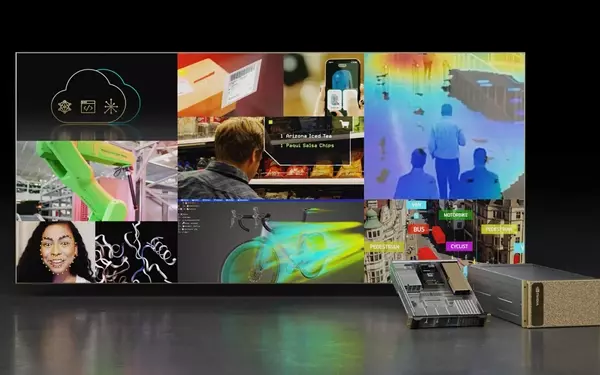
Nvidia's financial disclosures are expected to provide a comprehensive view of the artificial intelligence chip landscape, extending beyond its own performance to illuminate trends in the broader sector. The company, a pivotal force in designing accelerators for AI training and inference, holds a central position in this intricate ecosystem. The upcoming earnings announcement will undoubtedly captivate Wall Street, but the true implications will likely resonate through the entire supply chain, particularly for memory and data storage providers.
The artificial intelligence semiconductor sector operates as an intricately linked network where no single entity functions in isolation. Nvidia, a key designer of graphics processing units (GPUs) and other processors that power AI acceleration, stands at the nexus of this network. The company's forthcoming earnings report on August 26th will undoubtedly be a focal point for investors. However, the wider narrative will likely reveal trends that extend far beyond Nvidia's immediate financial figures.
Recent statements from prominent tech leaders, including Apple CEO Tim Cook, Amazon CEO Andy Jassy, and Space Exploration Technologies CEO Elon Musk, have underscored a significant issue: the escalating expenses associated with memory components due to burgeoning demand. This growing cost is a direct reflection of the memory and data storage industry's integral role in the digital landscape. Consequently, stakeholders closely observing Nvidia's performance should also monitor companies such as Micron Technology, Sandisk, and SK Hynix. Robust growth in Nvidia's data center operations would signal a sustained requirement for the specialized memory and storage solutions these firms provide, impacting their market positions and future outlook.
Nvidia's role in the AI chip supply chain is primarily as an architect rather than a direct manufacturer. The company designs sophisticated graphics processing units (GPUs) and other processors, then collaborates with an extensive network of partners to bring these designs to fruition. Within data centers, Nvidia's powerful parallel processing units form the computational backbone for large-scale chip clusters. Yet, the efficacy of each processor is intrinsically linked to the high-bandwidth memory (HBM) that supplies it with data and the robust storage systems that manage vast datasets. This symbiotic relationship places Nvidia in a coordinating position within the broader AI chip value chain, meaning its design choices directly influence the technical specifications and production volume forecasts for its upstream suppliers.
Discerning investors recognize that when Nvidia reports strong growth in its data center division, it implicitly confirms a rapid expansion of AI infrastructure by major technology companies and enterprise clients. This infrastructure development, however, is not confined to GPUs; it extends to the memory components that must keep pace with the accelerators' insatiable demand for data. Nvidia's newer chip architectures, such as Blackwell and Vera Rubin, integrate a greater quantity of HBM per unit compared to previous designs. Simultaneously, hyperscale data centers are deploying these systems in increasingly larger clusters. Therefore, any discussion of data center momentum during Nvidia's earnings call will almost certainly highlight the restricted availability and increasing cost of the memory that integrates these complex systems.
Nvidia CEO Jensen Huang is known for his forthright commentary on industry conditions. The prevailing memory market dynamics offer him a clear opportunity to address ongoing supply trends. Should he choose to do so, his insights would go beyond merely reiterating what other executives have stated. Instead, they would offer a more quantitative assessment of how the AI memory sector's dynamics are influencing the broader landscape, particularly from the vantage point of the company driving the most significant incremental demand for these components. This would provide valuable context for understanding the market's trajectory.
The anticipation surrounding Nvidia's earnings report extends to memory and storage providers like Micron, Sandisk, and SK Hynix, as their fortunes are closely tied to Nvidia's data center performance. These companies play complementary roles in the memory hierarchy supporting Nvidia's ecosystem. SK Hynix, for instance, has become a key provider of advanced HBM stacks, which are crucial components integrated into Nvidia's flagship accelerators. Micron has aggressively expanded its high-bandwidth offerings while maintaining a diverse portfolio of DRAM and NAND products for various environments, including cloud, mobile, and automotive. Sandisk, on the other hand, specializes in NAND flash, supplying high-capacity storage solutions and enterprise solid-state drives (SSDs) essential for storing the massive datasets and model weights processed by these AI systems. Consequently, any positive indicators from Nvidia's report, particularly regarding customer deployment timelines and the adoption of various memory technologies, would serve as a strong signal for these memory specialists, potentially impacting their future financial results and stock valuations. Moreover, any acknowledgment of supply chain bottlenecks would further underscore the pricing power currently enjoyed by memory suppliers in this burgeoning market.