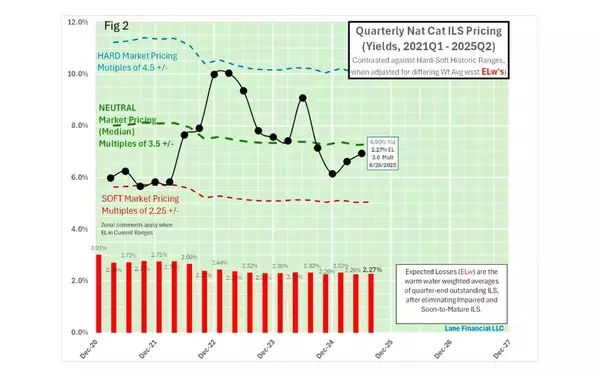
Analysts at Jefferies maintain a positive outlook on the property catastrophe reinsurance sector, asserting that despite some rate adjustments, the market's fundamental appeal remains strong. They emphasize that current pricing structures, which have held above 2022 benchmarks, preclude any classification of the market as 'soft.' This stability is largely attributed to a substantial inflow of new capital, primarily from emerging reinsurers, syndicates, and Insurance-Linked Securities (ILS) funds. This surge in capacity has effectively absorbed a roughly 10% increase in demand for limit purchases, allowing for a more favorable renewal environment for buyers without undermining the attractive returns available to underwriters.
A notable factor contributing to the market dynamics is the unprecedented volume of catastrophe bond issuance in 2025. This record-breaking activity, characterized by larger transactions and the entry of new sponsors, underscores the continued investor appetite for catastrophe risk. While cat bond spreads have seen a slight narrowing since the first quarter of 2025, they have largely stabilized at levels observed in late 2024. This resilience in pricing, coupled with robust capital deployment, suggests that the market is in a nuanced phase of adjustment rather than a sharp downturn, reinforcing the perception of sustained value within the property catastrophe reinsurance segment.
Sustained Value Amidst Evolving Rate Dynamics
The property catastrophe reinsurance market, despite experiencing some moderation in rates, continues to present an attractive proposition for participants, according to an analysis by Jefferies. This assessment directly addresses concerns that easing prices might signal a 'soft' market, a classification Jefferies firmly refutes given that current rate levels consistently surpass those recorded in 2022. The prevailing stability and profitability in the sector are primarily driven by a significant injection of fresh capital. This influx, originating from diverse sources including newly established reinsurers, syndicates, and a robust expansion in Insurance-Linked Securities (ILS) funds, has been more than sufficient to accommodate a projected 10% increase in demand for coverage. The strategic deployment of this capital has created a more balanced market, allowing for more favorable renewal terms for cedants without eroding the profitable margins for reinsurers.
This dynamic environment is further shaped by the record-setting performance of the catastrophe bond market in 2025. The substantial volume of new issuances, marked by larger transactions and the entry of new sponsors, highlights a sustained and growing investor confidence in this segment of risk transfer. Although there has been a slight compression in catastrophe bond spreads since the beginning of the year, they have largely maintained equilibrium with levels observed in the final quarter of 2024. This consistent pricing, even with increased issuance, reinforces the attractive risk-adjusted returns available in the catastrophe bond space. The Jefferies report aligns with broader industry perspectives, indicating that a full transition to a soft reinsurance market is still a distant prospect, likely several years away, underscoring the enduring appeal and strategic importance of property catastrophe reinsurance for investors and underwriters alike.
Capital Inflow and Cat Bond Market Resilience
The property catastrophe reinsurance market is experiencing a significant transformation, with Jefferies analysts noting that while rates have softened slightly, the market's inherent attractiveness persists, largely due to a substantial capital infusion. This fresh capital, predominantly from newly formed reinsurance entities and ILS funds, has exceeded the uptick in demand for coverage, estimated at approximately a 10% increase in limits purchased. This dynamic has enabled a more accommodating renewal environment for buyers, yet crucially, without undermining the robust returns available to underwriters. The balance struck between supply and demand, influenced by this capital surge, ensures that despite price adjustments, the foundational economics of the market remain compelling for investors seeking exposure to property catastrophe risk.
A pivotal element in this landscape is the unprecedented activity within the catastrophe bond market. The year 2025 has already seen record-breaking issuance volumes, driven by both larger individual transactions and the participation of new sponsors. This remarkable growth signifies a broadening and deepening of the ILS market, providing a highly efficient mechanism for transferring catastrophe risk. While the increased supply of cat bonds has led to a marginal tightening of spreads since the first quarter of 2025, these spreads have remained remarkably stable when compared to the close of 2024. This stability underscores the continued appeal of cat bonds as an investment vehicle, offering diversification and attractive yields even in a period of increased capital deployment. The resilience of catastrophe bond pricing, coupled with the overall attractiveness of property catastrophe reinsurance returns, indicates a mature and adaptable market capable of absorbing new capital and evolving demand without succumbing to a rapid softening phase.Related Articles